Resources
Explore five essential UI design books and find the best fit for visual design, usability, interaction patterns, and UX psychology.
Author

Tarik Eamin
Publish Date :
Read Time :
16 Minutes


Resources
Explore five essential UI design books and find the best fit for visual design, usability, interaction patterns, and UX psychology.
Author
Tarik Eamin
Publish Date :
Read Time :
16 Minutes

Key Takeaways
Refactoring UI is best for improving visual hierarchy, spacing, typography, colour, and overall interface polish.
Designing Interfaces offers the most comprehensive guidance on navigation, information architecture, interaction patterns, forms, and complex product structures.
Practical UI provides beginner-friendly rules for creating usable, accessible, and visually consistent interfaces.
Designing with the Mind in Mind explains the cognitive science behind established interface design guidelines.
Laws of UX introduce memorable psychological principles that designers can apply and explain easily.
For learning UI design, it might be confusing which book to read among so many books in the market. Moreover, each UI design book is different, some teaches polishing interface, some teaches navigation, workflows, reusable interaction patterns. Then some design books teach the psychology behind user behavior for understanding how to design UI.
So, keeping all the facts in mind, we have picked the 5 best UI design books for you:
Refactoring UI by Adam Wathan and Steve Schoger
Designing Interfaces by Jenifer Tidwell, Charles Brewer, and Aynne Valencia
Practical UI by Adham Dannaway
Designing with the Mind in Mind by Jeff Johnson
Laws of UX by Jon Yablonski
We went through each book maintaining depth, clarity, practical value, examples, accessibility and comparing it to modern product design and limitations.
Book | Main Focus | Best For | Best Quality |
Refactoring UI | Visual interface design. | Developers and self-taught designers. | Immediately actionable visual advice. |
Designing Interfaces | Interaction patterns and product structure. | Product and interaction designers. | Extensive pattern library. |
Practical UI | Usable, accessible interface design. | Beginners and working UI designers. | Clear guidelines with strong visual examples. |
Designing with the Mind in Mind | Cognitive foundations of UI rules. | UX professionals and usability specialists. | Explains why design guidelines work. |
Laws of UX | Applied psychology for designers. | Beginners, designers, and product teams. | Memorable and accessible explanations. |
The correct choice depends on if you need guidance regarding visual execution, interaction structure, accessibility or psychology.
We have gone through each of the books in this list thoroughly, compared it with each other, and then here is the information for you.

Refactoring UI is a visual design guide made for readers who want to make digital products but don't have formal training in graphic or interface design. Its core argument is that good interface design doesn’t come from artistic talent only, it also comes from learning hierarchy, spacing, typography, color, depth, and imagery.
The book won’t teach you design history or explain theoretically, rather talk about everyday problems which make an interface feel unfinished.
You should start your design with a real product feature, not by prematurely building the navigation and overall digital asset shell.
Don’t work in low fidelity before working on colors, icons, shadows, and other decorative details.
For ensuring that hierarchy depends on spacing, contrast, size, and weight rather than color alone, you must design in grayscale.
Be consistent with spacing, sizing, typography, and color systems, don’t choose values individually. Then use whitespace to enhance grouping, readability and visual focus.
It teaches that you must make flexible color palettes with multiple shades and contrast.
Enhance the images, empty states, backgrounds, borders, and default components without adding unnecessary decoration.
It’s not a full UI/UX book, it gives limited guidance on user interviews, information architecture, usability testing, product discovery, accessibility strategy, or complex interaction flows.
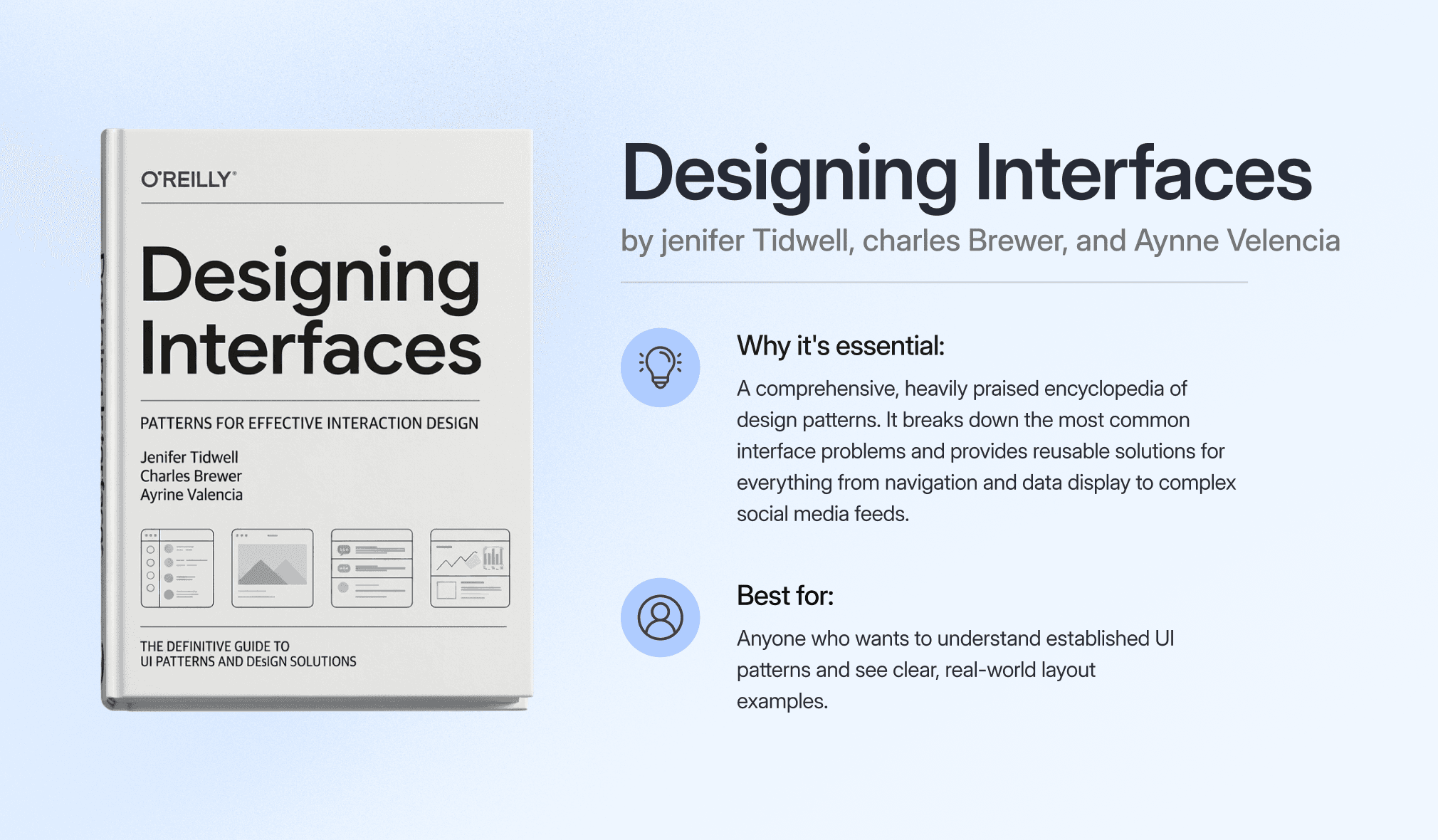
Designing Interfaces is known as the broadest and most reference focused book in this list. It doesn’t just concentrate on visual polish, rather focuses on recurring structures and behaviors which makes digital assets understandable, making design patterns the central subject.
The book discusses the interface as a connected system of navigation, content structures, feedback, forms, controls, and data rather than as a set of attractive screens.
It will help you to understand users’ goals, expectations, skill levels, vocabulary, and behavioural patterns before designing the interface.
It teaches how you can organise information through hierarchies, categories, timelines, locations, search systems, tags, dashboards, feeds, and alternative views.
How to design clear navigation through menus, deep links, breadcrumbs, progress indicators, escape routes, etc.
Gestalt principles, progressive disclosure, visual flow, responsive layout techniques and how to apply visual hierarchy.
Guide on selecting patterns for mobile screens, touch interactions, cards collections, infinite lists and bottom navigation.
How to make complex data easy for exploring through filtering, sorting, dynamic queries, data highlighting, and comparative visualisations.
Presenting lists by grids, split views, carousels, pagination, drill-down structures, and item-selection patterns.
Then it has a detailed guide on how to make consistent interfaces by using reusable components, design systems, UI frameworks and atomic design principles.
In short, this book is for designers who work on advanced SaaS tools, enterprise products, data heavy assets and products with multiple workflows.
The Designing Interfaces book works perfect as a handbook from starting to the end, but it can overwhelm a beginner who wants a simple guide only.
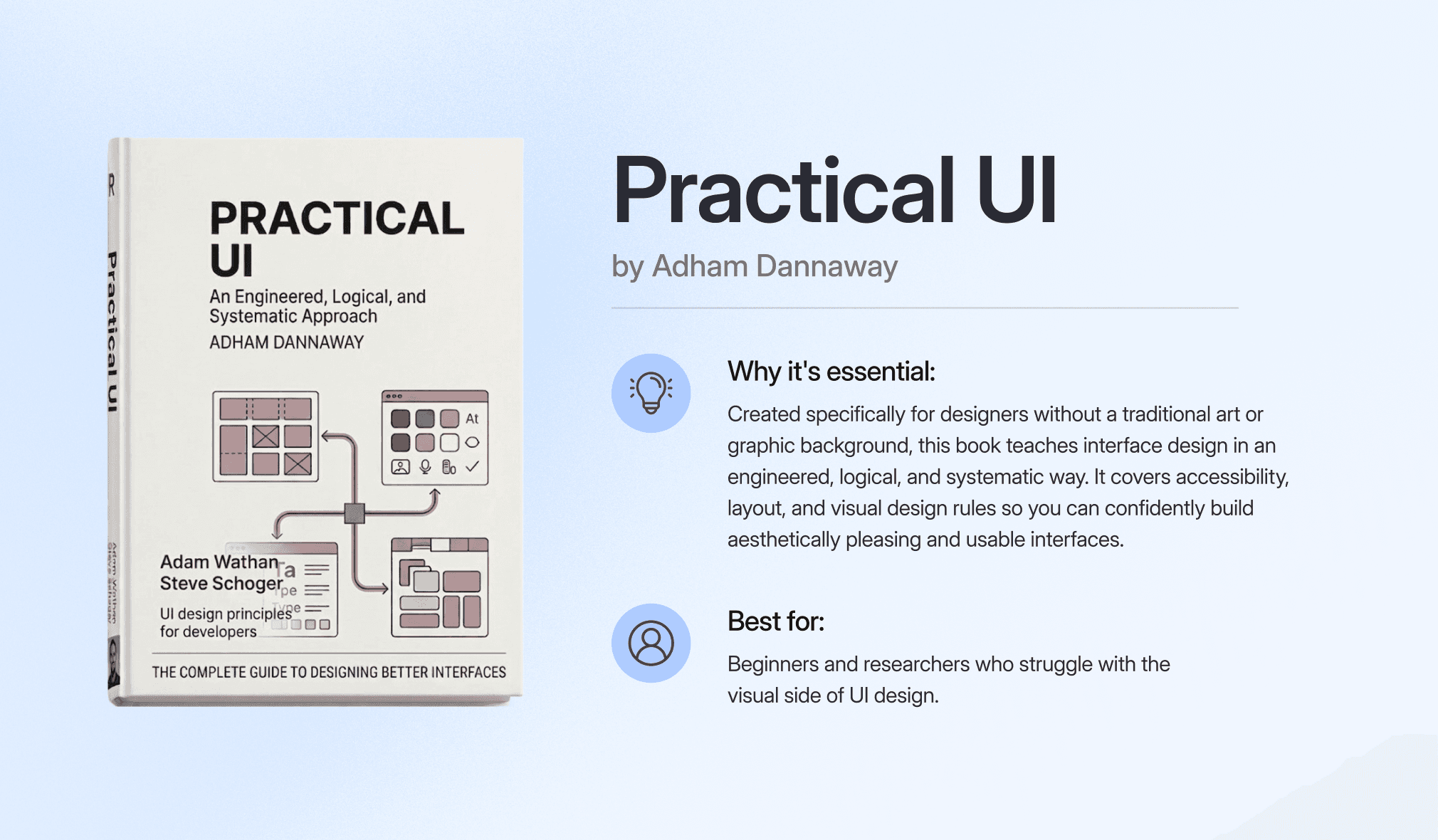
The book Practical UI is best as a visual guide to create interfaces which are clear, usable, accessible and aesthetic. The author's main message here is that UI design doesn’t mean moving elements to make the screen look right. But it’s to create meaningful design choices with logical reasoning. It believes that low contrast text, unlabeled icons, unclear buttons, weak grouping might look minimal but people might struggle to use the product.
For reducing usability risks, you must identify elements which may be confusing, inaccessible, difficult to read, or very easy to misuse.
You must create all designs with a logical rationale, not just by depending on taste or your personal preferences.
Remove unnecessary steps, choices, content and visual distractions for minimizing interaction cost and your cognitive load.
Don’t communicate meaning through colors only, that’s why create color palettes with contrast.
You must write concise copy in the interface using descriptive headings, and meaningful linking text.
Select between the dropdowns, radio buttons, checkboxes, toggles, steppers, and autocomplete based on the type of input required.
You must keep in mind to design interfaces that are understandable across different screen sizes, content lengths and user generated data.
The book primarily focuses on forms, labels, errors, and destructive actions along with visual design, interface writing, accessibility and more.
The book Practical UI can be categorized as a practical foundation, not a complete UI design methodology. It does not cover important issues like user research, product discovery, advanced data applications, experimentation or tell how to manage a large design system.
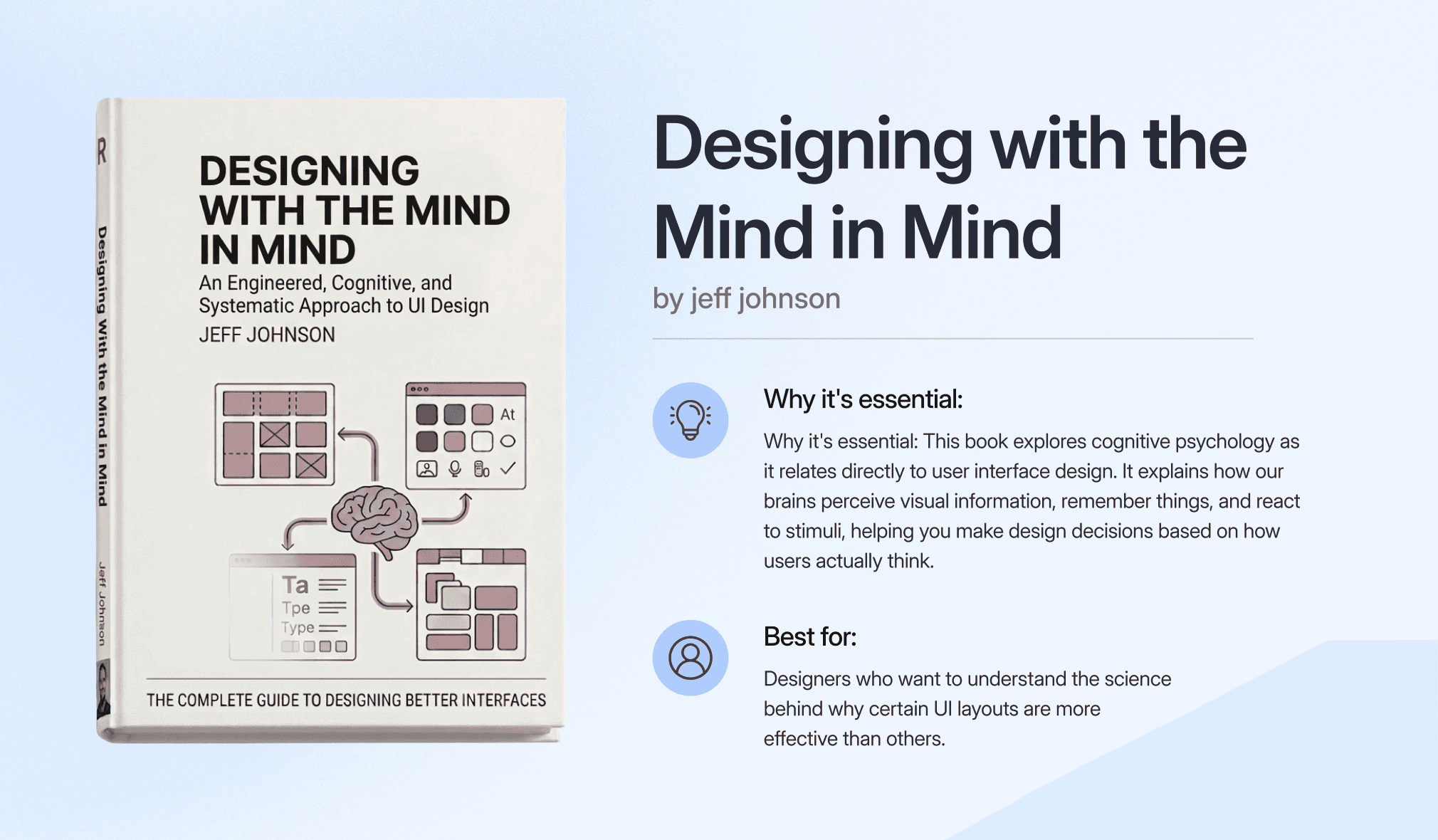
Usually UI design books guide the designers to maintain consistency, prevent errors, and provide clear feedback. But, here, Jeff asks the designers why those guidelines actually work. It describes the perceptual and cognitive science rules behind interface design. This book will teach you to understand human mechanisms behind the rules so you can decide which principle matters in a specific situation. And, also, the book Designing with the Mind in Mind is more analytical and theoretically based than all the others in our list.
It will teach you to learn how past experience, present context, and current goals shape what users notice and interpret.
Gestalt principles such as proximity, similarity, continuity, closure, symmetry, and figure–ground relationships are important to apply.
Present text strategically based on how people read, scan, recognize and interpret meaning.
Keep in mind strengths and limitations of human color vision, contrast perception and visual attention while designing.
Improve interaction efficiency by considering target size, movement, physical effort, and motor limitations.
Give the system feedback timely, so users can maintain attention, trust the interface, and understand what is happening.
Evaluate conflicting design guidelines by understanding the cognitive reasons behind them rather than applying rules.
UI designers who memorize rules struggle when two guidelines conflict, that’s why this book teaches perception, attention and memory to evaluate the consequences of each option.
The book doesn’t teach modern visual styling, design software, or current design system workflows and contemporary product development methods.
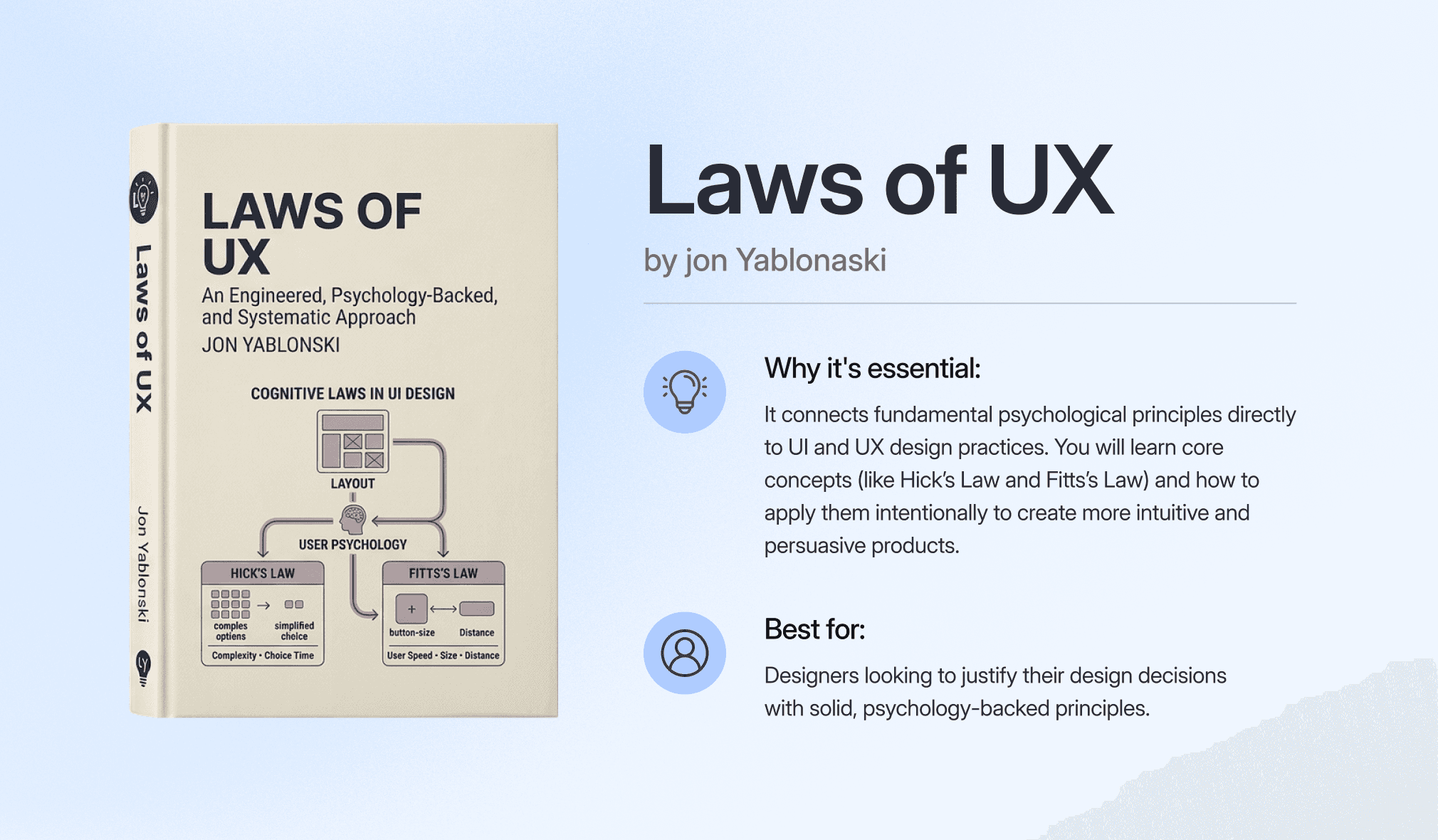
The Laws of UX book is an introduction book to psychological principles influencing digital product design. This book goes through ten UI/UX design principles thoroughly to guide you regarding human behavior, logical reasoning behind a design and a product, etc.
Jakob’s Law
Fitt’s Law
Miller’s Law
Hick’s Law
Postel’s Law
The Peak–End Rule
The Aesthetic–Usability Effect
The Von Restorff Effect
Tesler’s Law
The Doherty Threshold
It’s more than a list of principles, the book discusses how behavioral knowledge can be misused through dark patterns, forced actions, artificial urgency, etc.
We believe that ten detailed principles can’t represent the full fields of cognitive psychology, behavioral science, human factors, etc, regarding UI design. If you need immediate improvement in visual quality, then choose Refactoring UI.
Beginners should go with Practical UI, as it comes with the strongest starting point combining visual design, usability, accessibility, copy, component behavior, etc. If you need immediate improvement in visual quality, then choose Refactoring UI. And for the designers responsible for complex products, keep Designing Interfaces nearby as a reference.
Practical UI and Refactoring UI, these two books overlap, but their priorities are different from each other. The Refactoring UI book focuses on developing visual judgment and improving polish. Whereas, the Practical UI book gives more attention to accessibility, copywriting, forms, buttons, conventional controls, and usability risks.
If you want to learn UX psychology, then pick the book Laws of UX, the chapters are short and connected to familiar digital experiences. But, if you want to learn about perception, reading, attention, memory, learning and action then pick Designing with the Mind in Mind book.
UI design books can provide a better explanation for specific things than short courses but in reality, it can’t replace UI/UX courses. Courses help you to apply principles to the real problems, conduct research, test designs, respond to feedback and whatnot. UI/UX design books teach you the theories, but UI/UX courses teach you UI/UX design trends, and lets you play around in real life.
Upgrade to Grabui
Discover unlimited inspiration to help you Design fast. Build faster.


Share On


